
Every Breath I Take

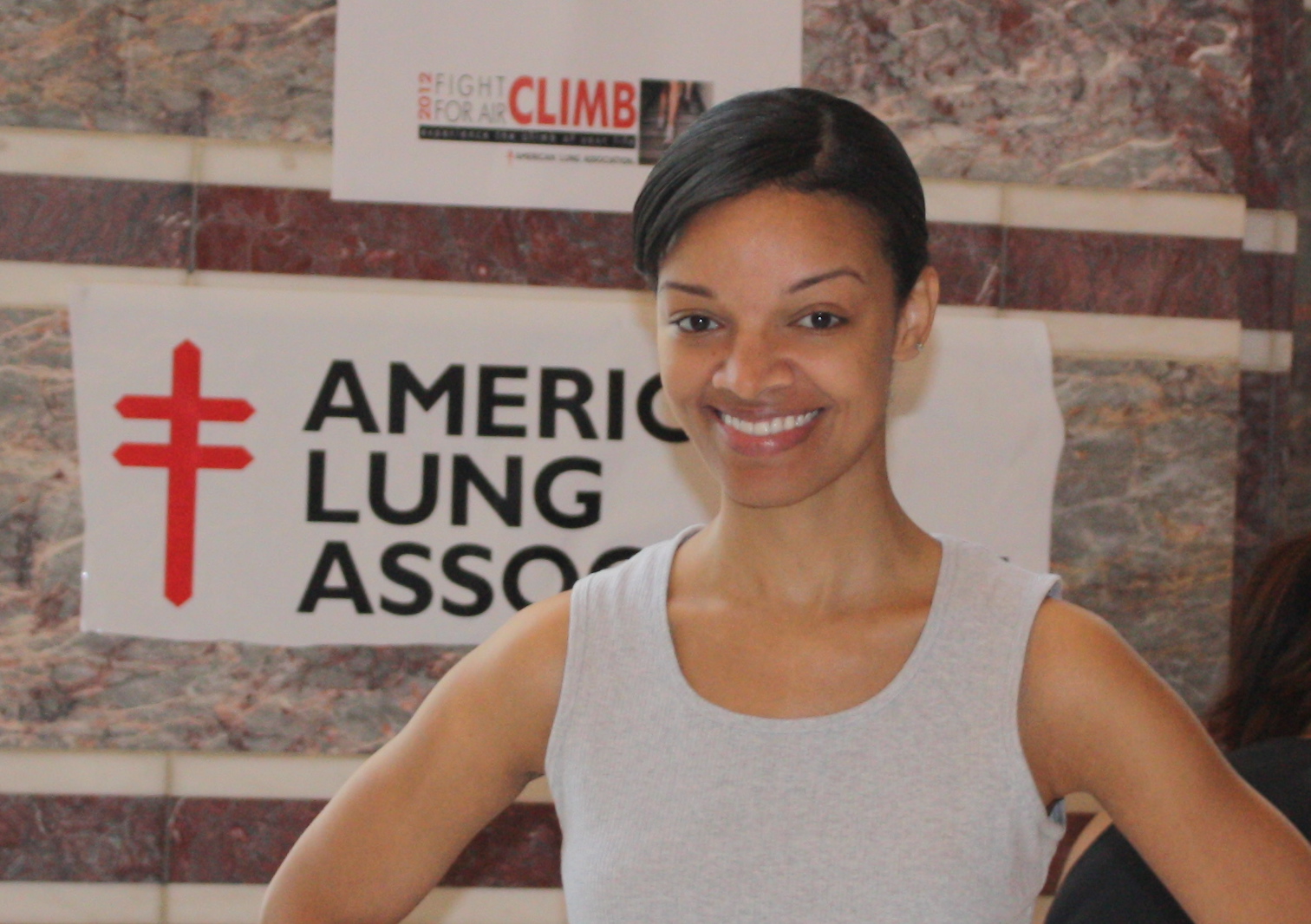
Smiling BEFORE the 2012 Fight For Air Climb

I did it! I completed The Climb of My Life last Saturday… a 50 flight vertical challenge to help raise money and awareness for the American Lung Association. While I didn’t adequately prepare for the challenge (I should have started training 8-10 weeks in advance. Instead, I trained 6 days a week for 5 weeks), I managed to finish the Climb in 11:47:57. Woo-hoo!  I just knew it was going to take me 20 minutes to cross the finish line, so I’m pretty pleased (and pleasantly surprised) with my non-athletic, rookie results. 🙂

The Bell Atlantic Tower- 50 flights (1,088 steps) to the top. Whew!

But let me tell you… that doggone Climb was no joke! I was cool for the first 10 flights or so, but by the time I hit the 35th floor, I was like “Why the heck did I sign up for this?” My legs were hanging in there, but the higher I climbed, the harder it was to breathe.  I, along with many other climbers, was beginning to suffer oxygen debt (physiological state produced by vigorous exercise, in which the lungs cannot supply all the oxygen that the muscles need).

I could actually hear myself breathing- loudly. Felt like my nose and mouth were Saran-wrapped. Now I really know why this is called the Fight for Air Climb. Sheesh! For the last 15 flights or so, all I could hear in that warm, narrow stairwell was the heaving surround sound of men and women trying to reach the top of the tower. Cool air was blowing from the vents but that offered little comfort. I began to feel nauseous. I wanted to give up in the. worst. way. Shoot, I willfully enlisted in this… I didn’t have to finish! Every breath I took felt like torture. You couldn’t tell me my head wasn’t about to explode. And I volunteered for this mess.

Yes, I volunteered for it. And I’m going to do it again next year. There are so many people in this world who don’t volunteer to have difficulty breathing: children plagued with asthma, people suffering from COPD (Chronic Obstructive Pulmonary Disease) attributed to air pollution, and the roughly 3,400 nonsmoking American adults who die of lung cancer each year as a result of breathing second-hand smoke. This Stair Climb made me ever so thankful for healthy lungs and my ability to inhale and exhale without difficulty or distress. Every breath I take is a blessing. I want to continue to breathe awareness about the deadly disease that strangles the air from so many- including my father.

I have a new-found respect for all the Firefighters of the world. Some of these guys finished The Climb quicker than me- wearing all their gear/equipment!

Why are the lungs important? Here’s what the American Lung Association has to say:

Text Box: Did You Know?  •	The right lung is slightly larger than the left.  •	The surface area of the lungs is roughly the same size as a tennis court.  •	A sneeze travels faster than a cough (60 vs 100 miles an hour).  •	A person at rest breathes about 12 to 15 times a minute.  That is at least 17,000 times a day and over 6 million breaths a year.

Oxygen, a basic gas, is needed by every cell in your body in order to live. The air that comes into the body through the lungs contains oxygen and other gases. In the lungs, the oxygen is moved into the bloodstream and carried through the body. At each cell in the body, the oxygen cells are exchanged for waste gas called carbon dioxide. The bloodstream then carries this waste gas back to the lungs where the waste gas is removed from the blood stream and then exhaled from the body. This vital process, called gas exchange, is performed automatically by the lungs and respiratory system.

In addition to gas exchange, the respiratory system performs other roles important to breathing. These include:

  • Bringing air to the proper body temperature.
  • Moisturizing the inhaled air to the right humidity.
  • Protecting the body from harmful substances. This is done by coughing, sneezing, filtering, or swallowing them.
  • The sense of smell.

WOW… our lungs are heavy-duty machines! Exercise is crucial to the maintenance of our lungs and our bodies as a whole. And stair climbing is great exercise! According to Dr. Oz, “Fitness gains from doing 11 minutes of daily stair climbing for eight weeks rival those of walking 36 minutes a day for six months.” Now put that in your pipe and smoke it (no pun intended)! When we don’t take care of our lungs, we decrease our ability to breathe freely and increase our risk for lung disease, stroke, and heart disease. I don’t like the sound of that.

And neither should you. Think you’re at risk? Know the Warning Signs. And understand what smoking does to your body.

Don’t voluntarily restrict your respiration. Do whatever it takes to lower your risk for lung disease. And take action to join the fight for healthy air. Changing an unhealthy lifestyle may be difficult, but it’s worthwhile. Take one step at a time.

Those few breathtaking minutes in that suffocating stairwell poignantly proved just how much I’ve taken advantage of my ability to breathe. Lord, please forgive me for taking my breath for granted. Every single one of the 17,000 breaths I take per day is a gift. Help me to use my gifts wisely… responsibly. With every breath I take, help me to speak life and not death. Help me to lift up and not tear down. Help me to spread Your Word, and not spread rumors, lies, and gossip. Show me how to be a better steward of the lungs You entrusted to me. Recognizing that every breath I take is on loan from You, show me how to use it for Your glory. You are the Air I breath. Amen.

~~~~~~~~~~~~~~~~~~~~~~~~~~~~~~~~~~~~~~~~~~~~~~~~~~

Do you know someone who has suffered from asthma, pneumonia, COPD, bronchitis, emphysema, lung cancer, SIDS (Sudden Infant Death Syndrome) or any other lung disease? Are you concerned about a loved one’s smoking habit? Please share your story/their story below. Your testimony could be the very catalyst necessary to change someone else’s life!

Investing In Peace

Dear Peace-Deprived,

Are you satisfied with the progress you’ve made so far this year? If not, you still have time to make some positive changes in 2011. There are three weeks left in the year. Lucky for you, it only takes 21 days to start/break a habit. What’s one positive change you would like to accomplish in 2012? What’s one thing you have no desire to bring into your New Year? What areas of your life are you struggling to find peace…  finances? your relationship with God? your marriage? your job? your health/weight? What do you do that stresses you out? Think about it. Go ahead… take a few minutes. Got it? Good. Now that you’ve identified your struggle, let’s do something about it. There’s a simple solution to your complex case: you have to start doing things that will produce harmony instead of hostility; serenity instead of stress. You have to start investing in peace.

An investment is simply a commitment of time, energy, or resources with the expectation of future gain. Simply put, it’s sowing a seed to reap a reward.  Your life is a giant investment portfolio of the decisions you make and the risks you take. The value of your portfolio (aka, your self-worth) is based upon how much weight you give to your experiences and accomplishments. Your daily actions and behaviors are an investment of your time/energy/resources that will reap either positive or negative results. If your portfolio is consistently experiencing poor performance, you have to get rid of what’s weighing you down and begin investing in things that will bring you peace. What stress/struggle do you want to be free from in 2012? Well, in order to make that happen, you’ve got to start tackling it today. You must become proactive instead of reactive (lead by your emotions). Let’s handle that, shall we? Here’s your investment plan:

1. State your objective. What is the primary goal you are trying to accomplish… a better handle on your finances? debt reduction? weight loss? lower blood pressure/cholesterol? Whatever your goal is, make sure it’s S.M.A.R.T. (Specific, Measurable, Attainable, Realistic, and Time-bound). Let’s say you want to build up your cash reserves. A S.M.A.R.T. goal would look like this:

“I want to have an additional $3,000 in my emergency fund by 12/31/2012. I will accomplish this goal by saving $250/month into my savings account for the next 12 months. I will monitor my progress quarterly. Because I have created a budget based on my income and expenses, I can realistically expect to save $750 per quarter (which will total $3,000 for the year). Yes, I can do this!”

Write the vision and make it plain. Put your objective in writing and read it aloud to yourself. You are more likely to reach a goal if you simply write it down. And hearing yourself voice your desire causes you to take ownership of your objective. Investing in peace is all about knowing what you want for yourself. You can’t change anyone else and nobody can change you. You have to do this for your own peace of mind.

2. Identify the positive rewards of accomplishing your objective.  Investing in peace will reap some wonderful rewards: less stress, more joy, better sleep, healthier attitude towards yourself and others, etc. Make a list of all the perks that come as a result of reaching your objective. This is the positive return on your investment.

3. Identify the negative consequences of not reaching your goal. Write down the “poor performance” you might experience if you don’t start investing in peace. Depending on your goal, some examples may include: depression, stress, anxiety, increased debt, reduced savings, heart attack, stroke, poor self-image, hopelessness, strife, etc. This is the negative return on your investment. Compare this list to the list of your positive rewards. Which would you prefer? Keep both of these lists in mind when you get discouraged. Oftentimes, we don’t think twice about divulging in unhealthy behavior when we don’t acknowledge the risks associated with it.

4. Get a Peace Partner. This is someone you trust who can respectfully hold you accountable to reaching your goal (and who is not struggling in the same area you are). They will be there to keep you on track when you want to give up. And they will celebrate your  accomplishments in the process. Having someone to hold you accountable will significantly increase your ability to make your dreams come true.

5. Manage your risk. Reduce/eliminate your distractions. What people, places, and/or things often distract you from staying on course? If you’re trying to save money, you probably shouldn’t hang out with friends who spend money like it grows on trees. If you’re trying to reduce your debt, stop carrying your credit cards in your wallet. It’s amazing how much easier it will be to focus on your goal when your vision isn’t clouded with temptation.

6. Take a daily Peace Pill. What is ONE Thing you can do every day to help you reach your objective? This is your Peace Pill. Doing ONE Thing consistently everyday for the next 21 days will help you form a positive habit that will not only assist you in reaching your goal, but will also give you more peace in the process. It’s much easier to reach a goal if you break it down into baby steps. Smaller pills are far less difficult to swallow. So, focus on changing just one bad habit at a time for 3 weeks straight.

7. Monitor your progress. Break your goal down into shorter intervals and monitor your progress accordingly. Check in with your Peace Partner to let them know how you’re doing and discuss any challenges/frustrations you might have. And don’t beat yourself up if you fall off the wagon… just jump right back on and keep it moving!

FYI: It’s not good enough to simply know these steps. You must implement them in order for them to work. Commit to this process and above all else, invite God to lead the way. Stay prayerful. Seek His face throughout each of these 7 steps. The Holy Spirit will guide you and the Prince of Peace will keep you. Investing in peace is about doing the little things that will produce positive results for your peace of mind. It’s about taking good risks. Make a conscious decision to invest in your peace every day- no matter how big or small. Consistency is key. Acknowledge how counterproductive it is to waste your time, money, and energy on things that will ultimately steal your joy. Short-term pleasure often produces long-term pain. Enough of that already! You’ve been going in circles for too long… can we agree that it’s gotten you nowhere? Take ownership of where you are and how you got there. Here’s the good news: when you focus on doing the right thing, you leave little room for the wrong thing to take root. Even when you experience the volatility of life, you can experience positive performance. You’ll be more at peace with yourself and others, and your quality of life will grow exponentially. Sounds like an excellent return on investment, if you ask me!! Peace is priceless… get yours today! 🙂

Practically Yours,

~The Practical Chick

P.S. If you’re dealing with long-term issues that you can’t seem to resolve on your own, or if you feel your situation is hopeless, don’t give up! Seek the counsel of your Pastor, therapist, or other mental health professional. For additional resources, check out ShareCare at www.share.care.com, or the National Alliance on Mental Illness (NAMI)…. www.NAMI.org or (800) 950-NAMI. Support, education, information, referral and advocacy is available to you! It’s not too late. You can do it, and they can help!